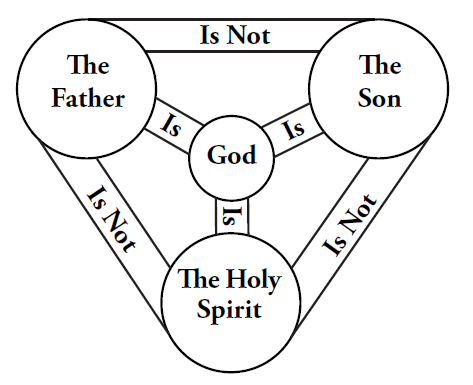
The word “Trinity” is not found in the Bible, but nonetheless, it’s a word embraced by Christians to describe the nature of God. A Christian believes in the Trinity because the Bible is ripe with teachings that exhibit the realities of the Trinity, beginning in Genesis 1:26, where God says, “Let Us make man in Our image“. The word Trinity attempts to communicate the belief that God is one Being, comprised of three distinct persons, who are spoken of in the Bible as the Father, the Son, and the Holy Spirit. The belief in a 3-in-1 God, also referred to as the Godhead, is an abstract concept that we are not able to completely understand. This makes the Trinity, to some degree, a mystery that we take by faith. As a Christian myself, I’m convinced of the reality of the Trinity, because the evidence demands it, even though my finite mind can’t fully grasp the concept. The Trinity isn’t the only mystery about God that Christians embrace by faith. Another example is the belief that God has never had a beginning; He is uncaused and has always existed. This belief is mysterious to our finite minds, but nonetheless, a Christian accepts God’s eternal nature because the evidence demands it; it’s the only plausible explanation for God’s existence. Some pastors and theologians do a better job than others at attempting to explain certain mysteries, like the Trinity. This essay attempts to better understand the Trinity, while accepting the reality that the Trinity will remain a mystery to mankind, at least on this side of heaven.
As man increases his knowledge about God, man ought not assume that the mysteries of God will decrease. This means that, what God chooses to make plain, is made plain, and what is harder to understand will require deeper thinking, and what is meant to be a mystery in this life, will remain so, despite man’s attempts to understand. This begs the question, “Why didn’t God clearly reveal every detail about Himself, so that even a child can fully understand Him?” I think the answer to that question is multifaceted. God is far bigger and greater than we can imagine. As well, God wants us to pursue Him, to pursue knowledge, to take some things by faith as the evidence leads; the mystery of the Trinity being one of them. What we do know about God, gives assurance to what we don’t know about God. So, in short, one might casually gloss over the Bible and perhaps miss the concept of the Trinity, but a student of the Word sees the wonderful nature of the triune God very distinctly!
We use words and statements to describe God, like Trinity, but words about God, are not God. Our language is simply not sufficient enough to communicate the magnitude of all that God is. In 2 Corinthians 12:4, the Apostle Paul had a supernatural experience where he was able to see and engage those in heaven. Paul was, “caught up into Paradise and heard inexpressible words, which a man is not permitted to speak.” Paul heard words that were unrelatable, not able to put into any words so as to be understood by mere men. Whatever he heard was not only inexpressible, he was not permitted to attempt to try to repeat; it wasn’t fit to be passed on. Some things will be revealed in God’s good timing.
Attempting to Explaining the Trinity
In 2007, a novel called The Shack, caused a stir with many people in the Christian Church. Some readers took the book to be more than just a fictional novel. In any case, the controversy was over the three persons of the Trinity being depicted in a way that seemed inappropriate. One figure (I can’t remember if it was the Father, Son, or Spirit) was manifest as a woman. This rattled some readers, who were upset that the author would depict God as a female, at least in part. The reality is, God is without gender, ethnicity, body, or age. Yes, it’s true that the second person in the Trinity did literally become a man, who we call Jesus. But aside from Jesus’ incarnation (coming in the flesh) God has no male attributes. Again, God is spirit; He’s immaterial. At Jesus’ baptism, another example of the Trinity in Scripture, we see the third person in the Trinity, the Holy Spirit, manifest as a dove, but that doesn’t mean the Holy Spirit is a bird.
God reveals to us many things about Himself, in ways that we can understand. He describes Himself by using anthropomorphic statements (anthro = man, morph = to change), which means to use human-like terms to describe something that’s not human. Perhaps you’ve seen the Planters Peanut commercials that feature a peanut with arms and legs, holding a cane? That’s an anthropomorphic way to display a peanut; giving it man-like features. With regards to God, in Psalm 144:7 the Psalmist says to God, “Stretch forth Your hand from on high; rescue me and deliver me.” God is a spirit and doesn’t have a body, much less a hand. The statement describes God’s protection, not God’s body. Or, Psalm 91:4, “He will cover you with His pinions, and under His wings you may seek refuge.” Again, God’s not a bird, but we can relate to the protective example of how a bird protects it’s young, and understand the metaphor about God.
God uses the earthly relationship of father and son to describe the first and second persons of the Trinity; the Heavenly Father and the Son of God. When the second person of the Trinity became a man, Jesus, it was this incarnation (coming in the flesh) that creates the Father/Son context. We see this in Luke 1:35, when the angel Gabriel tells the virgin Mary that she’ll have a son, “The Holy Spirit will come upon you, and the power of the Most High will overshadow you; and for that reason the holy Child shall be called the Son of God.” Jesus isn’t the son of Joseph, or any earthly man, but the Son of God, as having been conceived by the Spirit. This verse also reveals distinctions between the Son and Spirit. In short, Jesus wasn’t born of the Heavenly Father in the way humans are begotten by their fathers. Neither was Jesus created. These terms “Heavenly Father” and “Son of God” are anthropomorphic terms that express a quality of relationship; love, reverence, authority, intimacy, and obedience, in a way that our simple minds can better understand how we are to perceive God, and how we are to respond to Him. We are to respond to our Heavenly Father as Jesus did.
If God is spirit, and has no gender, then why do we refer to God using male pronouns, like He and Him? God has purposed that there be roles of position, known as headship, and in keeping with these roles, it’s fitting for God to speak of Himself using male pronouns. One example of Biblical headship is 1 Corinthians 11:3, “But I want you to understand that Christ is the head of every man, and the man is the head of a woman, and God is the head of Christ.” Given God’s headship, we see masculine pronouns describing Him, like in 1 John 1:5-7 where both the Father and Son are in view, “God is Light, and in Him there is no darkness at all. If we say that we have fellowship with Him and yet walk in the darkness, we lie and do not practice the truth; but if we walk in the Light as He Himself is in the Light, we have fellowship with one another, and the blood of Jesus His Son cleanses us from all sin.” This verse describes both the nature of the Father, being Light, and that His Son, Jesus, cleanses us from all sin. Being God, and holding positions of headship, the Father and Son are spoken of with male pronouns.
Compare the doctrine of the Trinity to the doctrine of the incarnation: God becoming a man in the person Jesus. These doctrines sort of mirror each other. Interestingly enough, in the doctrine of the Trinity, we have multiple persons, three, sharing one nature, God. In the incarnation, you have a single person with multiple natures; both God and man at once. Philippians 2:7 describes some of what Jesus needed to do in order to become fully man, while still being divine God. It says He, “emptied Himself, taking the form of a bond-servant, and being made in the likeness of men.” The Lord “emptied Himself,” which means to put aside some of His godly attributes, those “omni-qualities,” so that He could become a human. For example, He was no longer omnipresent (everywhere at once), since a human can only be one place at a time. He was no longer omniscient (all knowing), thus having a human brain, Jesus “grew in wisdom” (Luke 2:52), and prayed for guidance and the will of the Father. Lastly, He was no longer omnipotent (all powerful), as He regularly became weak/tired, could be tempted, and His body was ultimately killed. Jesus was filled with the power of the Holy Spirit when He needed strength/ability to do extraordinary things. Part of what Jesus accomplished in becoming a man, was to show us how to behave in relation to God; obedient, dependent, allegiant, surrendered, etc.
Scriptures Highlighting the Trinity
John 1:1 and 1:14, talk of Jesus’ divine nature; existing both eternally as God and with God, “In the beginning was the Word, and the Word was with God, and the Word was God.” (vs. 14) “And the Word became flesh, and dwelt among us, and we saw His glory, glory as of the only begotten from the Father, full of grace and truth.” So, the Word “was” God and the Word was “with God.” Both God, and with God. And in verse 14, the two designations “Word” and “God” become “Son” and “Father.” So, the second person of the Trinity, before He became the human called Jesus, existed eternally with the first person of the Trinity, the Father.
Jesus, the incarnate Son of God, the Word become flesh, spoke of the Holy Spirit as a distinct (third) person in John 14:26, “But the Helper, the Holy Spirit, whom the Father will send in My name, He will teach you all things, and bring to your remembrance all that I said to you.” And, in John 16:7 & 13, Jesus says, “But I tell you the truth, it is to your advantage that I go away; for if I do not go away, the Helper will not come to you; but if I go, I will send Him to you. But when He, the Spirit of truth, comes, He will guide you into all the truth; for He will not speak on His own initiative, but whatever He hears, He will speak; and He will disclose to you what is to come.” Jesus speaks of the Holy Spirit as another person who is sent from the Father. The Spirit is not some active force or will of the Father, as though the Spirit stems from the Father, but the Trinity emphasizes independent persons; not stemming from any.
The Trinity also doesn’t destroy the monotheistic view, that there is one God. The Bible reiterates the truth of one God with verses like Deuteronomy 6:4, “Hear, O Israel! The LORD is our God, the LORD is one!” As well in 1 Timothy 2:5, “There is one God.” And James 2:19, “You believe that God is one. You do well.” And again in 1 Chronicles 17:20, “O LORD, there is none like You, nor is there any God besides You.”
Eternal Love is a Necessary Requirement of God’s Nature
Throughout eternity past, the Trinity has enjoyed the perfect fellowship they shared; co-worshipping one another, enjoying their perfect unity, and experiencing love between them. They are, and always have been, complete and perfect, lacking nothing. This begs the question, “Why then, did God create the universe and the human race anyway?” Was God bored or did He feel underappreciated? Not at all. God made humans because God wants us to be in fellowship with Him; not for His own benefit, but for ours! God’s not the beneficiary in the relationship, we are. He was already perfectly praised before He made us. In short, He didn’t need praise from a lesser being to give Him any sense of worth. Since He was experiencing perfect love from within the Trinity, it was not necessary that God create other beings, like angels or men. Instead, it was reasonable that He would want to create angels and men, so that we can enjoy His love for the rest of eternity. Again, we benefit, not Him! That’s what love is; looking to the betterment of others.
If God was a single-person deity and not a triune being, then creating angels and humans wouldn’t make sense. Take for example, Islam’s god, “Allah,” who they claim is a single-person deity. Allah is simply the Arabic word for god, but it additionally serves as the name of their deity. As a single-person deity, why would Allah create anything? Allah would have been in existence from eternity past, alone forever and having nobody to fellowship with, having no way to express love or to receive love. It would only be reasonable to assume that Allah was satisfied in that condition. Having no possible way to experience love himself, it’s only logical to say that a single-person deity cannot be a loving deity. There’d be no reason for Allah to create anyone to pass love onto, as he himself wouldn’t know what love is. Islam, seeing this dilemma, tries to remedy this. From the Islamic Quran and Hadiths, Muslims allege that Allah has 99 names. These 99 names are supposed to describe how he is in eternity, but one of these names is “the loving.” As flattering as that is to say, it’s illogical, as Allah can’t be loving when there was nobody for him to love! So, when a faith, like Islam, attempts to wipe out the concept of a Trinity, it tries to remove the very thing that is so amazingly perfect about God; His love! Fortunately, a triune deity, like the God of the Bible, is necessarily a God of love. He delights for others to experience His love. Therefore, creation isn’t needed, it’s simply within the character of a naturally loving God to delight in creating others than can benefit from His love. Jesus says in John 17:24, “Father, I desire that they also, whom You have given Me, be with Me where I am, so that they may see My glory which You have given Me, for You loved Me before the foundation of the world.” Jesus reiterates the eternal love relationship within the Trinity, and His desire for man to be joined in that fellowship, to be with Jesus as Jesus is with the Father. In other words, the God of the Bible didn’t create out of boredom, loneliness, or egotistical selfishness.
Three Roles in Perfect Unity
The Trinity enjoys co-equality. One example is found in Matthew 28:19, “Go therefore and make disciples of all nations, baptizing them in the name of the Father and of the Son and of the Holy Spirit”. Though equal, all divine, co-worshipping one another, and calling each other God, the distinct persons of the Trinity have different roles to play in the great work of redemption.
God the Father – the first person of the Trinity. He is the One to whom we pray. For example, Matthew 6:9, “Pray, then, in this way: ‘Our Father who is in heaven, Hallowed be Your name.” He is the sovereign governor over all, as we see in Acts 1:7, “He said to them, “It is not for you to know times or seasons that the Father has fixed by His own authority.” He is the Creator of life and of life’s purpose. We see in 1 Corinthians 8:6, “yet for us there is one God, the Father, from whom are all things and for whom we exist, and one Lord, Jesus Christ, through whom are all things and through whom we exist.” The Father – from whom all things came, and Jesus – through whom all things came. The Father – for whom we exist, and Jesus – through whom we exist.
Jesus the Son – the second person in the Trinity. Jesus is Immanuel, which means, “God with us,” which is who He is. The name Jesus means “God Saves”, which is what He does. Christ (Greek) or Messiah (Hebrew) means “Anointed One”, which is His office. The Bible teaches that the second person in the Trinity became a man, named Jesus. Therefore, we believe in the humanity of Jesus Christ, that He was born of a virgin. Jesus led an absolutely sinless life, performed many miracles, and died as the substitution and atonement for those who accept Him as God and Savior. Atonement means “to cover over,” to cover over sin, as the way of reconciliation between God and sinful man. Jesus made this atonement through His human blood, as we see in Leviticus 17:11, “For the life of the flesh is in the blood, and I have given it for you on the altar to make atonement for your souls, for it is the blood that makes atonement by the life.” Jesus’ death on the cross is God the Father’s sole provision for the forgiveness of sin. John 14:6 says that, “no one comes to the Father but through Me.” Jesus Christ literally rose from the dead; bodily, not in spirit. He appeared to many eye witnesses who died believing they had seen and engaged the risen Jesus. Forty days after His resurrection, Jesus ascended back into heaven (Acts 1). Jesus will personally return in power and glory to judge the living and the dead, as Matthew 25:31-32, “But when the Son of Man comes in His glory, and all the angels with Him, then He will sit on His glorious throne. All the nations will be gathered before Him; and He will separate them from one another, as the shepherd separates the sheep from the goats.”
The Holy Spirit – the third person in the Trinity. The Holy Spirit, was and is God. The Holy Spirit convicts people of sin. Convict means “to bring light.” The Spirit prompts and quickens us to be aware of our sinful nature and our need for the forgiveness that God provides. When a person entrusts themselves to Jesus, they are regenerated by the Holy Spirit. Regenerated means to be reborn, or born again of a different nature. We see this in John 3:6, “That which is born of the flesh is flesh, and that which is born of the Spirit is spirit.” So, a believer is made new in the nature of the Holy Spirit; alive eternally. The Holy Spirit gives spiritual gifts to believers. These gifts are the divine enabling by the Holy Spirit, through which individual Christians fulfill their function within the Church. We see an example of this in 1 Corinthians 12:11, “But to each one is given the manifestation of the Spirit for the common good. For to one is given the word of wisdom through the Spirit, and to another the word of knowledge according to the same Spirit; to another faith by the same Spirit, and to another gifts of healing by the one Spirit, and to another the effecting of miracles, and to another prophecy, and to another the distinguishing of spirits, to another various kinds of tongues, and to another the interpretation of tongues. But one and the same Spirit works all these things, distributing to each one individually just as He wills.” The Spirit enables the Christian to live a holy, victorious, and fruitful life that greatly glorifies God. This happens when the believer allows the Spirit to govern his life. When that happens the following works of the Holy Spirit are manifest through the believer’s life, “love, joy, peace, patience, kindness, goodness, faithfulness, gentleness, self-control,” Galatians 5:22-23.
Conclusion
As Father, God is the Creator of all. He is the source of life. He provides for His creation. He is ruler over the whole world. We were created to enjoy Him forever. As Son, God revealed Himself to us in the person of Jesus Christ. While Jesus walked on the earth, He was both fully God and fully man. Jesus understands how difficult life on earth can be because He experienced it all firsthand. And because of His perfect sacrifice on the cross, Jesus is the only way to salvation. As Holy Spirit, God empowers us to live a life of dedication to Jesus and to be a witness of His grace to the world around us. The Spirit gives us gifts for this task and also teaches us about God’s character and kingdom. There’s no easy way to wrap our brains around this complex subject, but the bottom line is that you can’t put God in a box. He’s bigger than we can ever imagine and He’s too complex for our minds to fully comprehend.