
The Bible says that Adam, the first man, was formed by God from the dirt. Genesis 2:7 says, “Then the LORD God formed man of dust from the ground, and breathed into his nostrils the breath of life; and man became a living being.” From Adam until today, many people throughout human history have been worshipping the Lord, their creator. Yet, there are some that don’t believe that humans were made by God, or at least they refuse to yield to that truth. An anecdote about creation goes something like this – Using common dirt, scientists have discovered how to create human life. By taking dirt, and harvesting its essential nutrients, minerals, bacteria, and other unique faculties found in the soul, a team of scientists have discovered how to create a human being. This team declared, “See, we don’t need God! In fact, we challenge God to a man-making competition, using nothing but dirt!” God accepted their challenge, and on the day of the competition, both God and the team of scientists reached down to the ground and scooped up a handful of dirt. God stopped them and said, “Whoa, get your own dirt!” The point being, as man becomes increasingly scientifically savvy, it’s arrogant to think that we can substitute knowledge for God.
This essay will provide a few talking points that demonstrate that the theory of evolution is a myth and scientifically impossible. Before these points are given, it’s important to lay a foundation as to why people cling onto to theories like evolution as a reason to explain the origin of man and the universe. Despite God revealing Himself to us through nature (read Romans 1 in the Bible), men still seek other explanations of how mankind originated. Using the scientific method, man continues to learn more about the realities of the universe. This is good. The scientific method is a wonderful tool that allows us to know more about ourselves and the universe we live in. Christians do, and should, embrace science as a gift from God. It’s important to note that there has never been a scientific discovery that has disproven any claim in the Bible, but more will be said about that later in this essay.
As science provides more clarity, additional discoveries continue to narrow down the options for non-believers who want to hold to their belief that the universe and life didn’t come from God. In other words, the more science reveals, the more clever a non-believers excuse must become in order to continue to deny the existence of God. Take for example Francis Crick, who in 1953, along with James Watson, co-discovered DNA. Crick, a brilliant scientist, had labored to deny the existence of God, and before he discovered DNA, Crick held to the theory of evolution. After he demonstrated that DNA is the basis for genetic transmission is living things, Crick said, “There is extreme difficulty in explaining how life could have evolved in the time it had here on earth. An honest man armed with all the knowledge available to us now, could only state that in some sense the origin of life appears at the moment to be almost a miracle.” So, does this mean Crick will own that God created man and the universe? No. Crick admitted that life must have had an intelligent designer but instead of pointing to God, he theorized, in a 1972 paper he co-authored with biologist Leslie Orgel called “Directed Panspermia,” (which means “seeds directed everywhere”) that extra-terrestrial beings (aliens), from an advanced civilization, and possibly facing extinction, sent primitive life forms to earth in a spaceship and seeded life on this planet.
This begs the question of why would Crick feel the need to insert an imaginary race of aliens, without any evidence to support it? This answer is simple. If Crick were to admit that God created the universe then by default it would mean that he was accountable to God. Philip Johnson, Berkley law professor, in his book, “Darwin on Trial,” said this, “When a scientist of Cricks caliber feels he has to invoke undetectable spacemen, maybe it’s time to consider that life is what it so evidently seems to be – the product of creative intelligence, God.”
Arthur Keith (British anatomist and anthropologist, 1866–1955) said, “Evolution is unproven and improvable. We believe it because the only alternative is special creation.” At least Keith is willing to own that he’s avoiding the accountability of God.
Likewise, Sir Julian Huxley (British evolutionary biologist, philosopher, author 1887–1975), one of the world’s leading evolutionists in his day, said, “I suppose the reason we leaped at Darwin’s book, “The Origin of Species”, was because the idea of God interfered with our sexual mores.”
A Christian’s faith is not blind faith, which would mean believing in something without evidence. Instead, a Christian’s faith is evidence based. As such, a Christian highly values science and the evidence that science provides. The Bible claims that the universe came into existence at the spoken command of God, and that God created man and all the animals of this world, already in their advanced adult states, just as we observe them today. This essay will use reason and science to demonstrate the validity of these Biblical claims. I’ll be using four main talking points; 1) Fossil Record, 2) Irreducible Complexity, 3) Information Systems, and the reality that 4) Everything that Begins to Exist has a Cause. You’ll notice that none of the arguments against evolution will depend on the Bible.
Lee Strobel, a former atheist who turned to Christianity after examining evidence, said this about the theory of evolution, “Looking at the doctrine of Darwinism, which undergirded my atheism for so many years, it didn’t take me long to conclude that it was simply too far-fetched to be credible. I realized that if I were to embrace Darwinism and its underlying premise of naturalism, I would have to believe that: 1. Nothing produces everything 2. Non-life produces life 3. Randomness produces fine-tuning 4. Chaos produces information 5. Unconsciousness produces consciousness 6. Non-reason produces reason….The central pillars of evolutionary theory quickly rotted away when exposed to scrutiny.”
It’s critical to confront yourself with this statement – When someone holds a strong opinion in the face of little evidence it’s a sign that they’re not using critical thinking skills. Belief should follow the facts, not come before them. What one wants to believe shouldn’t determine what they believe. The key to learning is valuing truth.
The Fossil Record
Charles Darwin invented a theory of biological evolution that became known as “Darwinism” or, “Darwinian Evolution.” This theory theorizes, in summary, that the universe came into existence by way of an explosion called the “Big Bang.” This means that despite not having a cause, all matter came from nothing, from a fixed finite location somewhere, and eventually all of the known universe somehow ordered itself through random chance, giving us today what is the fine-tuned solar system that we live in. As for life on planet earth, a “primordial soup” was created when lightning struck a water puddle which somehow created single cell organisms, which, through random chance and time, evolved over billions of years into fully developed humans, animals, etc.
If Darwin’s theory of evolution were true, and single celled organisms gradually evolved into complex animals and humans, it would insist that there would be trillions of trans-mutational species found in the fossil record. Trans-mutational means an animal or organism that is mutating, changing, or transitioning into an entirely different type of specie (like a fish becoming a cat). Billions of years of evolution would result in trillions of examples of fossils where we can observe the various stages of evolution mutating/changing throughout the fossil record. Charles Darwin himself knew that the fossil record would have to show these trans-mutational fossils in order for his theory to hold any weight. In an 1859 writing, Darwin was grieved over the fact that so far, no trans-mutational fossil had yet been found. Not even one. He wrote, “As this process of extermination (survival of the fittest) has acted on an enormous scale, just the number of intermediate varieties (trans-mutational species), which have formerly existed on earth would be truly enormous. Why then is not every geological formation and every stratum full of such intermediate Iinks? Geology assuredly does not reveal any such finely graduated organic chain; and this, perhaps, is the most obvious and gravest objection which can be urged against my theory.” In his 1860 book, “The Origin of Species”, page 189, Darwin writes, “If it can be demonstrated that any complex organism existed which could not possibly have been formed by numerous, successive, slight modifications, my theory would absolutely break down.” And, “To suppose that the eye, with all its inimitable contrivances for adjusting the focus to different distances, for admitted different amounts of light, and for the correction of spherical and chromatic aberration, could have been formed by natural selection, seems, I freely confess, absurd in the highest degree.”
In short, Darwin himself admits that in his life, no missing link, not even one trans-mutational fossil had been discovered, and furthermore, that the fossil record alone would either validate or invalidate his theory. So, what does the fossil record show? Does it show layers upon layers of trillions of trans-mutational species through the ages? No, not at all. In fact, the fossil record shows that all known fossils are already found in their fully developed stage, just as we find that same specie today. If you were to dig deep into the earth and turn back around and come up toward the surface, there would be no fossil beds and then sudden bursts of fossil beds with fossils of fully developed species. This would suggest that there was no life, then suddenly all life appeared quickly with no evolutionary process. This would validate the claims of the Bible that God spoke and suddenly there were animals of all kinds, already in their fully adult stages.
Other evolutionists have also admitted that the fossil record is lacking in Darwinian evidence. Paul Moody who wrote “Introduction to Evolution” discusses the trilobite, a complex multi-celled little creature that he believes is the first record of fossils that we have. The problem is that the trilobite appears suddenly in the fossil record with no prior ancestry and is itself amazingly complex. A trilobite fossil is shown here, demonstrating many uniformed patterned pieces, and just on this side of the animal alone.
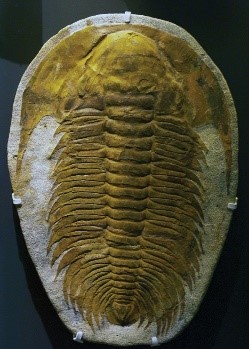
In his book on page 153, Moody writes, “A fossil record of the trilobite history hasn’t yet been found.” Also, pertaining to humans he writes, “We encounter an unfortunate gap in the fossil record. We do not yet have fossils of possible human ancestors living in the later portions of the Pliocene.” Regarding plants he writes, “Botanical evolutionary theory is mainly unsupported by fossil evidence.”
Daniel Axelrod, Paleontologist was quoted in Kirby Anderson’s book, “Fossils in Focus,” where Axelrod said, “One of the major problems of evolution is the occurrence of diversified multi-cellular marine invertebrates in the lower Cambrian strata of rocks, and their absence in rocks of greater age. When we turn to examine the forerunners of these fossils they are nowhere to be found.”
George Simpson, Paleontologist at Harvard University claims, “We know that in the Cambrian strata of rock, all the invertebrate animals in the world suddenly appear as completely complex creatures with no ancestry before them, which is totally inexplicable to the evolutionist.”
Richard Dawkins, an outspoken atheist, and author of the, “The Blind Watchmaker” says, “The Cambrian strata of rocks, vintage about 500 million years are the oldest ones in which we find most of the major invertebrate groups. And we find many of them already in an advanced state of evolution, the very first time they appear. It’s as if they were just planed there, without any evolutionary history.”
Gordon Taylor, author of, “The Greatest Evolutionary Mystery’ (pages 60, 64, 74) writes, “There are no intermediate forms between finned and limbed creatures in the fossil collections of the world. Once again, the evidence for gradual evolution is missing. How and when did the changes occur? We do not know. The fossil record is blank just when we need it the most. Apparently, the transition to mammals occurred in the last Triassic; unfortunately, the fossil record is most fragmentary at this point. More than a dozen (essentially modern) groups appear simultaneously in the fossil record. It is a puzzle unlikely ever to be solved.”
W.E. Swinton of the British Museum of Natural History says, “The origin of birds is largely a matter of deduction. There is no fossil evidence of the stages through which the remarkable change from reptile to birds was achieved.”
Stephen Stanley, Paleontologist at John’s Hopkins University, when commenting on the fossil records found at the famous Big Horn Basin in Wyoming, “The fossil record at Big Horn does not convincingly document a single transition from one species to another.” One can see the obvious dilemma that scientists have today when attempting to defend evolution. Stephen Stanley also authored a book in 1981 called “The New Evolutionary Time Table.” On page 72 he writes, “The fossil record and only the fossil record provides direct evidence (for evolution). Everything else is just made up.” Here, we see Stanley admit that all evidence for evolution is false except the fossil record which would be the single saving proof for Darwin’s theory. Yet, he and his colleagues are on record as claiming the fossil record simply doesn’t provide evolutionary evidence!
I, Chaplain Darin, was born in the 1970’s, and growing up, I kept hearing in science class how scientists and geologists were looking for the “missing link”. This would be a single fossil that would finally demonstrate evidence to support the claims of Darwin. Evolution doesn’t just need a link; the whole chain is missing!
Here are some of the famous alleged “missing links” that have been debunked.
Archaeopteryx
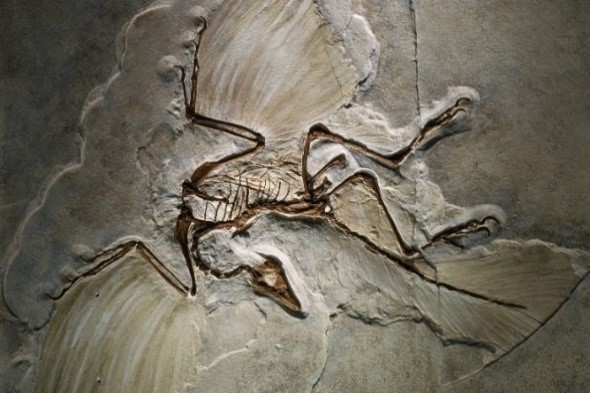
Here are evidences published by the ICC – International Conference on Creationism. Published by Ian Taylor, (1990) “The Ultimate Hoax: Archaeopteryx Lithographica,” The Proceedings of the International Conference on Creationism: Vol. 2, Article 58. You’ve likely seen the above Archaeopteryx image in a text book. I had a picture of this hanging on a wall in a science class at a junior college I attended. This “missing link” was supposed to be a fossil demonstrating a trans-mutational stage between lizard and bird. Coincidentally, within a matter of months after the German edition of Darwin’s The Origin of Species was published, paleontologist Hermann von Meyer came into possession of the “fossil”, but only a single feathered version. Although the feather looked perfectly modern, it was supposed to have been found in strata of the Jurassic period and therefore 150 million years old. The “rare fossil” was handled and sold by Dr. Karl Haberlein. Oddly enough, less than two months later, in 1861, Haberlein had another Archaeopteryx specimen for sale, this time it was of the entire creature except for its head. Soon, details of this second “find” where given to Paleontologist Andreas Wagner who had previously discovered and named a small dinosaur “Compsognathus”, seen here.
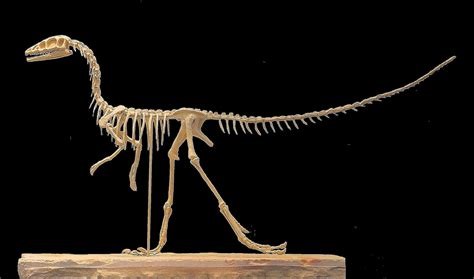
Wagner recognized from the description what seemed to him to be his Compsognathus but with feathers! Wagner cautioned Darwin followers that this was not a legitimate discovery, but rather a forgery. Richard Owen, in charge of the British Natural History Museum bought the second “discovered”
Archaeopteryx fossil and after examining it stated, “The fact that it had fully developed feathers classified it as a bird and there were speculations as to whether the head would have had teeth or not; having teeth would place it more centrally between the reptile and the bird and thus be a more perfect confirmation of Darwin’s theory.” Sure enough, years later, another Archaeopteryx turned up complete with head and it did have teeth! In the meantime, Charles Darwin himself could not be convinced that the Archaeopteryx was a trans-mutational fossil. Darwin mentioned it in the 1866 (fourth) edition of his Origin book as merely “a strange bird”.
Much later, in 1984, Dr. Lee Spetner of the Leizman Institute, Israel, persuaded British Natural History Museum authorities to let him examine the Archaeopteryx specimen. He, along with British scientist Sir Fred Hoyle, who was also a skeptic, co-operated on examining the “fossil”. Many photographs were taken using techniques intended to highlight the contours. Hoyle quickly published a book containing photographs and documentation of the charges and counter-charges of fraud. Hoyle and Spetner concluded that Archaeopteryx was actually a genuine fossil of the Compsognathus, an extinct reptile, to which had been added the impressions of modern feathers. Hoyle suggested that the forgers had spread a mixture of finely ground limestone and gum arabic thinly across the dinosaur’s limb and tail areas, then pressed modern feathers into this mixture. The feathers were removed after the cement had completely hardened.
Piltdown Man
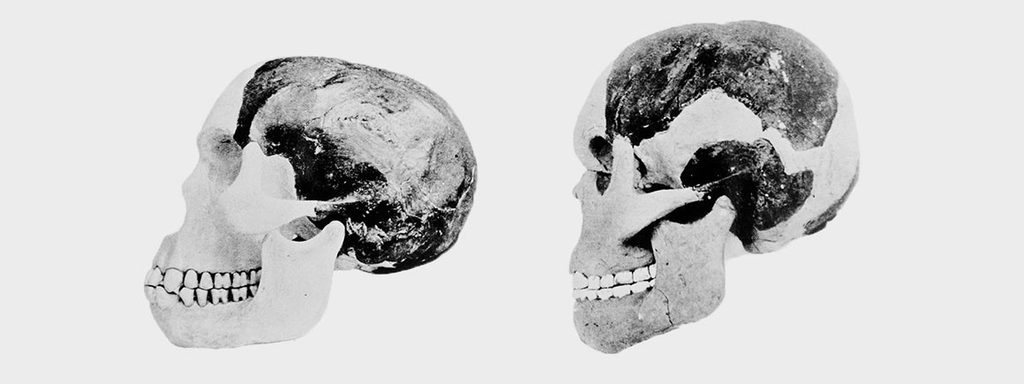
In 1912 Charles Dawson, an amateur archaeologist claimed to have discovered the ‘missing link’ between ape and man. He had found part of a human-like skull in Pleistocene gravel beds near Piltdown village in Sussex, England. Dawson wrote to Arthur Smith Woodward, Keeper of Geology at the Natural History Museum at the time, about his find. Dawson and Smith Woodward started working together, making further discoveries in the area. They found a set of teeth, a jawbone, more skull fragments and primitive tools, which they suggested belonged to the same individual. However, in 1949 new dating technology eliminated the possibility of the Piltdown Man being the missing link between humans and apes. Following this, biological anthropologist Dr Joseph Weiner and human anatomist Wilfrid Le Gros Clark, both from Oxford University, worked with Dr Oakley to further test the age of the Piltdown findings. Their results showed that the skull and jaw fragments actually came from two different species, a human and an ape, probably an orangutan. Scratches on the surfaces of the teeth, visible under the microscope, revealed that the teeth had been filed down to make them look human. They also discovered that most of the finds from the Piltdown site had been artificially stained to match the local gravels. The conclusion: Piltdown Man was an audacious fake and a sophisticated scientific fraud.
Nebraska Man
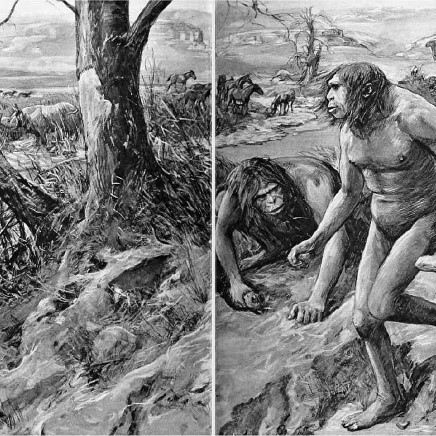
In 1917, geologist Harold Cook, conducting an archaeological dig in 1917, unearthed a molar tooth, a single, lone molar tooth in the state of Nebraska. He gave it to a paleontologist Henry Osborn, the Director of the American Museum of Natural History in New York and a Professor at Columbia University. An artist, using a lot of imagination, drew an entire man, the “Nebraska Man”, a hairy ape-man, from just this single tooth. Several years later, it was discovered that the tooth was from a pig! The whole ape-man idea was a complete mistake.
Irreducible Complexity
Imagine if you surgically removed certain parts of the human body; an arm, a leg, an eye, a kidney. The body would still live on. So, you continue to surgically remove other pieces; the other arm, the other leg, the reproductive system, one lung, the nose, the other eye, etc. You can surgically remove many parts of the human body and it can continue to live. However, you will get to a point, where if you remove just one more part, then the whole body dies. This demonstrates irreducible complexity. This means that complex living organisms require many functioning parts to all be intact and working at the same time in order for the whole organism to exist at all. In short, no organism can come together gradually (evolve over time) as Darwin suggests. When any animal or other multicellular organism is reduced even to its simplest form, it is still too complex to exist unless every piece is working properly and all at the same time. Darwinism suggests that a single celled organism evolved into a human over billions of years. This is purely science fiction, or religion.
Consider the following example when reviewing Darwin’s theory of evolution. In order for a single celled organism to evolve into a human being, what does the single cell need to develop first? How about a mouth to eat. What does it start with, a lip? How could the lip develop without skin to attach to? How could the lip function without a muscular system to move it? What good is a lip if there’s no mouth to make the lips function operational? Nor would there be a digestive system in place which would allow food to be processed by the body. But, a digestive system requires a central nervous system in order to function. These systems require an entire vascular system to feed blood to the lip to keep it alive, not to mention the respiratory system to allow the vascular system to operate, and so on and so on. In other words, you can’t produce one single part and expect it to survive the developmental process without all the other parts also being in place. Gradual evolution is scientifically impossible.
Or, consider the complexity of just one eukaryotic cell, a typical cell from a human being, which is about the tenth the size of a head of a pin, and yet it contains about 3 billion units of DNA. The body is radically complex and so many things have to be in place all at once or life can’t move forward, period.
Another thing that evolutionists have no answer for, is whether or not the male or the female evolved first. Think about it, in plants, animals, and humans, there are two genders, male and female, and they need to be existing and cooperating simultaneously for them to exist at all. So, how does evolution account for this need? It can’t! Did the male plant evolve first? Did the female elephant evolve before the male? If a female evolved first, over a course of thousands or millions of years, how could it continue to replicate itself without a male counterpart? Or, what if the male began to evolve at the same time as the female counterpart, but they were not within reach of each other? Suppose a male cat was evolving while the female cat was evolving, but they were 100 or 1,000 miles apart, what then? The idea of gradual evolution falls short for so many reasons.
Information Systems
If a fish were to evolve into an air breathing reptile, where would it get the information it needed to know how to produce lungs and the entire respiratory system? We see how information systems and irreducible complexity work hand in hand to expose the impossibility of the evolutionary theory. How could the fish slowly/gradually develop that lung unless it had an entire respiratory system in place to sustain the evolving lung as it developed? Where would the physical matter come from that would be needed to create the lung? As one part of a body cannot sustain itself through the evolutionary process, it’s equally impossible that organisms could creatively design itself into another specie, since no organism can produce new genetic code.
Science demonstrates that over time, living organisms lose genetic information, they don’t gain it. In order for evolution to be possible, a specie would have to have the ability to produce new genetic information so it can go from one specie to another; building upon itself with each new generation. This is scientifically impossible. Science has shown us that nature can only reproduce itself after its own kind; seed bearing plants only produce similar plants, cats only produce cats, etc. Nature can’t create nature by itself, nor can it turn itself into another form of nature.
Everything that Begins to Exist has a Cause
Scientific observation, along with common sense, assure us that from nothing, nothing comes. The material and physical universe can’t create itself. As an example, an elephant can’t simply manifest itself and pop out of thin air. However, the atheistic world view, better known as the Naturalistic world view, asserts that the physical universe did in fact create itself, and yes, it created itself out of nothing. Yet, when asked “How can a natural thing come into existence on its own,” the naturalist has only to say, “science has no answer.” Something material must come from a source. Something that begins to exist must have a cause. The physical universe began to exist; therefore, the material universe had a cause.
Both creationists and evolutionists agree that the universe had a beginning. One scientific demonstration to this fact is the second law of thermodynamics, which shows us that energy in the universe is winding down, and thus if the universe eternally existed, then logically the energy in the universe would have already run out and stars like our Sun would have ceased to be long ago. Our universe demonstrates age, not eternality.
So, since the universe had a beginning, what is the source of that beginning? The Bible claims that God made the universe. However, a naturalist might argue, “If God made the universe, then who made God?” The error in this question is quickly seen. For example, if one responds by saying, “God was made by ‘x’”, then the next obvious question would be, “Then who or what made ‘x’?” And so on, and so on. This becomes what is known as an eternal regression; an infinite number of “then what created that” scenarios which leads you to being no closer to the truth than when you began. Using reason, we conclude several things –
- The universe consists of time, space, and matter.
- The universe had a beginning, which means it had a cause.
- Something or someone that caused the universe to exist, must be itself unaffected by time, space, and matter. In other words, who or what caused the universe had to be outside the universe.
- Conclusion – Something or someone must have existed eternally, never having had a beginning, and this eternal being must be self-existent, self-sustained, all powerful and all knowledgeable in order to bring such a universe into existence.
Ask yourself, “Is God the best explanation for the origin of the universe?” If not, why not? What else is?
Microevolution vs. Macroevolution
Microevolution is a true and observable reality. This is a term that demonstrates how one specie can adapt to an environment. For example, some dogs get thicker coats of fur in the winter, or some birds develop longer beaks in the winter to get below the snow to find food, etc. These are micro (or small) adaptations within a specie. However, Darwinism suggests a macro (large) evolution theory, where a bird can become a cat, etc. In macro evolution, one specie is not just adapting to its environment, but rather becoming an entirely different specie all together. This is unobservable by science and undemonstrated in anything found in the known world. As much as breeders have tried to create new kinds of dogs and cats, they’ve never been able to turn a dog into a cat, or a cat into a dog. Macroevolution is a myth.
Evolution is a Religion
People that hold to the belief in evolution will often say that creationists are simply believing in creation as a matter of religion and not science. This is simply not true. The evidence we find in science is best answered by God and the creation account found in the Bible. Creationists let the evidence guide them to the most plausible explanation. But what’s so interesting to me is that evolution really is a religion. Why? For the atheist, their definition of faith is to believe in something that cannot be demonstrated by evidence; to have faith is to believe in something when there’s no real answer for it. Evolutionists hit a wall where they have to say, “Science hasn’t yet revealed the chain of evolutionary fossils,” or, “We don’t know what caused the Big Bang, science doesn’t account for that.” In short, evolutionists are maintaining a belief that has left the scientific realm. The second they abandon science in order to draw their conclusion, they make evolution a religion.
Additional Scientific Insights on Creation
Frank Allen, Ph.D., Cornell University, Professor of biophysics, University of Manitoba, recipient of the Tory Gold Medal, Royal Society of Canada, commented on the ponderous protein molecule, the basic building block of all life, and noted that it has about 40,000 atoms arranged in an exceedingly complicated pattern. Regarding the possibility that even a single molecule, such as that, could have been produced by chance, he said, “The amount of matter to be shaken together to produce a single molecule of protein would be millions of times greater than that in the whole universe. For it to occur on earth alone would require almost endless billions of years (10 to the power of 243). But proteins as chemicals are without life. It is only when the mysterious life comes into them that they live. Only Infinite Mind, that is, God, could have foreseen that such a molecule could be the abode of life, could have constructed, and made it live.”
Merritt Stanley Congdon, natural scientist and philosopher, holder of three doctorates from Webster and Burton Universities, and a member of several learned societies, stated that, “There are no facts yet wrested from the intriguing mysteries of this strange onrushing cosmos which can in any degree disprove the existence and intelligent activities of an unconditioned, personal God. On the contrary, when we as careful scientists analyze and synthesize the data of the natural world, we are observing only the phenomena of the operations of that unseen Being who cannot be found by mere scientific seeking, but who can and did manifest himself in human form. For science is indeed watching God at work.”
John Cleveland Cothran, Ph.D., Cornell University, mathematician and scientist, Chairman of Mathematics and Science Division, Duluth, University of Minnesota, said, “Lord Kelvin, one of the world’s greatest physicists, has made the following significant statement: “If you think strongly enough, you will be forced by science to believe in God.” I must declare myself in full agreement with this statement …. Now the material realm, not being able to create itself and its governing laws, the act of creation must have been performed by some non-material agent …. That is to say, we unhesitatingly accept the fact of the existence of the supreme spiritual being, God, the Creator and Director of the universe.”
Donald Henry Porter, Ph.D., University of Indiana, distinguished mathematician, and physicist, declared that, “Whatever process of nature is considered, or whatever question of origins is studied, as a scientist, I derive satisfaction only by placing God in the leading role. God is the central figure in every picture. He alone is the answer to the unanswered questions.”
Edward Luther Kessel, Ph.D., University of California, outstanding zoologist, and entomologist, also editor of distinguished scientific publications, affirms that, “During recent years, scientific research has been yielding new evidence supporting the traditional philosophical proofs that there is a God. Not that this new evidence was necessary, for the old proofs were more than adequate to convince anyone whose mind was not encrusted in a capsule of prejudice.”
W. O. Lundberg, Ph.D., Johns Hopkins University, physiologist, and biochemist, noted writer in scientific fields, observed that, “The scientific method is founded on orderliness and predictability in natural phenomena. It is precisely this orderliness and predictability that constitute a revelation of God in nature. Order and predictability in the framework of non-existence of God is a meaningless contradiction.”
Paul Clarence Abersold, Ph.D., University of California, member of National Research Council, specialist in nuclear physics, Manhattan Project, Atomic Energy Commission, an authority on neutron radiation and isotopes, wrote, “Although science can develop very plausible theories of a cataclysmic birth of the universe resulting in galaxies, stars, worlds, and atoms, it cannot explain where all this matter and energy came from and why the universe is so constituted and ordered. Straight thinking and clear reasoning demand the concept of God.”
Marlin Brooks Kreider, Ph.D., University of Maryland, physiologist, member of American Society of Professional Biologists, said, “Both as an ordinary human being, and also as a man devoting his life to scientific study and research, I have no doubt at all about the existence of God. There definitely is a God…. I see at the beginning of the cosmic road, not eternal energy, or matter, not “inscrutable fate,” not a “fortuitous conflux of primordial elements,” not “The Great Unknown,” but the Lord God Almighty.”
George Earl Davis, Ph.D., University of Minnesota, a specialist in solar radiation, and widely known physicist, denied the popular notion that atheism is more prevalent among scientists, noting that such a thesis has never been proved. He then added, “Such a popular belief is, in fact, contrary to impressions gained at first hand by many of the scientists themselves. These revelations in the natural world of transcending intelligence … are, for me, sufficient evidence of a God. They are sufficient even without the inference that no material thing can create itself.”
John William Klotz, Ph.D., University of Pittsburgh, noted specialist in genetics, began his answer to this question with two quotations from the Old Testament, “The heavens declare the glory of God and the firmament shows His handiwork. The fool hath said in his heart, “There is no God.” This world of ours is so complex and intricate that it could hardly have risen by chance. It is filled with intricacies which require as their cause an Intelligent Being, not blind fate.”
Irving William Knobloch, Ph.D., Iowa State College, Professor of Natural Science in Michigan State University, wrote, “I believe in God because mere chance could not account for the emergence of the first electrons or protons, or for the first atoms, or for the first amino acids, or for the first protoplasm, or for the first seed or for the first brain. I believe in God because His divine existence is the only logical explanation for things as they are.”
In the book The Anthropic Cosmological Principle, authors Barrow and Tipler lay out 10 steps that they say would be necessary to the course of evolution, each of which is so improbable that before they were to occur the sun would have ceased to be a main sequence star and would have destroyed the earth. This seems to suggest that if evolution were to have occurred, it would have had to have been a miracle! In other words, evolution would literally be evidence for the existence of God! The Christian’s advantage when it comes to the argument of the origin of the universe is that he can be open to what the evidence shows us. However, the atheist is stuck with evolution…he has no choice to stay locked in on the theory because following the evidence condemns the theory of evolution.