
One of the most famous events is history is chronicled in a book titled after the event itself; Exodus, a word meaning “mass departure.” This second book of the Bible provides great details about the Lord delivering the enslaved Israelites out of Egypt. Jacob (whose name was also Israel), had moved into the land of Egypt under the blessing and protection of his son, Joseph, who had ascended to the rank of second highest in command in all of Egypt. You can read about this in the last ten chapters of Genesis. Jacob would die in Egypt and his descendants, known forevermore as Israelites, would eventually grow and become a nation unto themselves. Pharaoh (the Egyptian word for king) blessed Jacob and his homestead by giving him the best land in Egypt, a territory known as Goshen. However, long after Jacob had died, other Pharaoh’s rose up and ruled; Pharaoh’s who knew nothing of the graciousness that was extended to Israel many generations before. In time, the Egyptians loathed the growing number of Israelites, seeing them as intruders and unworthy of equality. Israelites became enslaved by Egypt for centuries to come, according to Exodus 12:40-41, “Now the time that the sons of Israel lived in Egypt was four hundred and thirty years. And at the end of four hundred and thirty years, to the very day, all the hosts of the LORD went out from the land of Egypt.”
God had appointed a man named Moses, along with his brother Aaron, to lead the exodus of Israelites out of Egypt and into the wilderness where they would learn to trust the Lord. Moses and Aaron confronted Pharaoh to let the Israelites go free, but Pharaoh refused to release his slaves. Exodus 7:14, “Then the LORD said to Moses, “Pharaoh’s heart is stubborn; he refuses to let the people go.” In response, God chose to demonstrate His power and sovereignty: God’s ability to govern over all things. Therefore, God brought forth a series of plagues, ten in all, that became part of one of the greatest series of events ever known.
This essay aims to examine the purpose behind the ten plagues as they magnify God’s dominion over nature and over the demonic world of false gods. As each plague is brought forth, it not only devastated the land of Egypt, but it personally exposed the fraudulency of the various “gods” that Egypt had been devoted to. In fact, all false religious beliefs and false gods are simply the worship of demons, disguising themselves as God. “The sacrifices of pagans are offered to demons, not to God,” 1 Corinthians 10:20, and Psalm 106:37, “They even sacrificed their sons and their daughters to the demons.” Additionally, you’ll notice that the timing of each plague (having been prophesied by Moses), the intensity of each plague, and the suddenness of each plagues ending, show that these plagues could only be the handiwork of God. Lastly, the design of the plagues was specific, using the local characteristics of the Nile valley in the plagues themselves.
The 10 Plagues in Order
1. The Plague of Blood – Exodus 7:14-24.
Specific details are given in verse 19, showing that no drop of water in all of Egypt was safe, “Then the LORD said to Moses, “Say to Aaron, ‘Take your staff and stretch out your hand over the waters of Egypt, over their rivers, over their streams, and over their pools, and over all their reservoirs of water, that they may become blood; and there will be blood throughout all the land of Egypt, both in vessels of wood and in vessels of stone.’” Had the blood been limited to the Nile, that would have been horrible, but might have been dismissed as something less than the work of God, such as a disease that killed all the animal life in the river. But since water supplies unconnected to the Nile were also turned to blood, things like pools or water pitchers, the plague showed that something divine had happened.
This might have been convincing enough, but God had allowed Satan to wield some supernatural powers through some of the magicians that served Pharaoh. Exodus 7:22, “But the magicians of Egypt did the same with their secret arts; and Pharaoh’s heart was hardened, and he did not listen to them (Moses/Aaron), as the LORD had said.” The magicians were able to mimic this miracle, but on a much smaller scale, yet still impressive enough that it prompted Pharaoh to dismiss Moses and Aaron as a couple of spell-casters. Thus, Pharaoh didn’t have any fear that God was behind this, “Then Pharaoh turned and went into his house with no concern even for this,” Exodus 7:23. The Egyptians had to dig new wells in order to drink, as this plague went on for a week (Exodus 7:24-25).
This was all part of God’s plan. If Pharaoh had been impressed with this miracle, and let the Israelites go, then people would exalt Pharaoh’s name throughout the world, heralding him as “Pharaoh the merciful”. But, God wanted to rightly get the credit for delivering His people. Afterall, it was God who delivered Israel, not Pharaoh who released Israel. This reality will be made clear throughout the story.
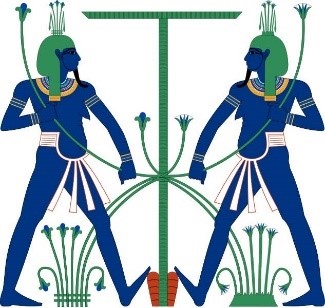
In this plague, the demon “Hapi” (depicted below) is exposed as fraudulent. Hapi was the Egyptian God of the Nile; a water bearer. If Hapi was a real god then Hapi would have been able to protect the Nile and overturn God’s plague on the water.
2. The Plague of Frogs – Exodus 8:1-15
As the plague of blood didn’t persuade Pharaoh, God delivered a plague of frogs. Exodus 8:3, “The Nile will swarm with frogs, which will come up and go into your house and into your bedroom and on your bed, and into the houses of your servants and on your people, and into your ovens and into your kneading bowls.” The extent of the frogs was equivalent to the extent of the blood. Frogs were everywhere the Egyptians tried to sit, sleep, or prepare food. This plague went beyond just being a nuisance, but was a grotesque epidemic.
This plague might cause someone to leap (pun intended) to the wrong conclusion and say, “Of course a plague of frogs came next. If all the waterways were turned to blood, then naturally frogs that lived in those waterways would be forced out onto the land. The blood brought the frogs, not God.” While there’s some logic to this claim, the extent of the frogs, and the fact that they hadn’t come until after Moses had prophesied they would, shows that this again was the handiwork of God. Besides, a lot of animals lived in the Nile, such as crocodiles and hippopotamuses, and there wasn’t plagues involving those animals.
Once more, Satan was allowed to operate through Pharaoh’s magicians and replicate this miracle on a smaller scale. Although the king’s magicians had relative power, this time though Pharaoh acknowledged the Lord. Pharaoh likely realized his magician’s talents were far weaker and that they didn’t have the ability to make the plagues go away. Pharaoh calls upon Moses to plead to God, “Entreat the LORD that He remove the frogs from me and from my people; and I will let the people go,” Exodus 8:8.
Here’s what happened next, according to Exodus 8:13-15. “The LORD did according to the word of Moses, and the frogs died out of the houses, the courts, and the fields. So they piled them in heaps, and the land became foul. But when Pharaoh saw that there was relief, he hardened his heart and did not listen to them, as the LORD had said.” Pharaoh promised God one thing, “Get rid of the frogs and I’ll release the slaves,” yet once God delivered, Pharaoh went back on his word. How many times have we seen people make “promises” to God, like, “Lord, deliver me and I’ll be faithful to you,” only to ditch their promise and return to sinful habits.
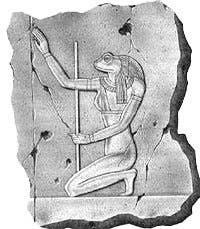
In this plague, the demon “Heket” (depicted below) is exposed as fraudulent. Heket had the head of a frog and was the Egyptian goddess of fertility and renewal. She’s associated explicitly with the last stages of the flooding of the Nile, and is exalted as the one who brings forth goodness from the Nile, such as water for this year’s crop and the annual fertility replenishment of water animals like frogs, fish, etc. In this plague though what came forth from the Nile was a curse and not a blessing, exposing Heket’s ineptitude to have any control over what’s produced in the Nile.
3. The Plague of Gnats – Exodus 8:16-19
Due to Pharaoh’s hardness of heart, the Lord brought a third plague, that of gnats. Aaron was told to take his staff and strike the dust of the ground. Once he did, the dust became gnats that filled the land of Egypt. “There were gnats on man and beast. All the dust of the earth became gnats through all the land of Egypt,” Exodus 8:17. With this plague and all the others going forward, Satan was no longer able to keep up with the magnitude of the miracles. Thus, Pharaoh’s magicians could no longer mimic what God had done. “Then the magicians said to Pharaoh, “This is the finger of God.” But Pharaoh’s heart was hardened, and he did not listen to them, as the LORD had said,” Exodus 8:19. Despite realizing that Moses and Aaron were for real, Pharaoh seemed to tolerate the gnats, as there’s no mention here that Pharaoh pleaded for the plague of gnats to cease.
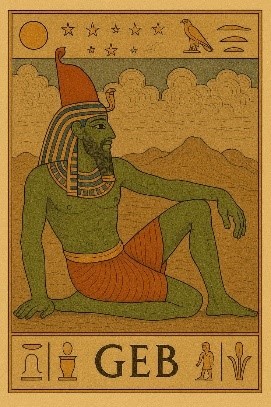
In this plague, the demon “Geb” (depicted below) is exposed as fraudulent. Geb was the Egyptian god of the earth, and was over what came out of the earth. Geb was specifically associated with vegetation, healing the ground, and providing habitable land. In this plague though what came forth from the ground was a curse and not a blessing, exposing Geb’s ineptitude to have any control over what the ground produced.
4. The Plague of Flies – Exodus 8:20-32
Once again God sent Moses to speak to Pharaoh, saying, “For if you do not let My people go, behold, I will send swarms of insects on you and on your servants and on your people and into your houses; and the houses of the Egyptians will be full of swarms of insects, and also the ground on which they dwell. But on that day I will set apart the land of Goshen, where My people are living, so that no swarms of flies will be there, in order that you may know that I, the LORD, am in the midst of the land,” Exodus 8:21-22.
Remember, Goshen was the territory in Egypt reserved for Jacob’s descendants. In Genesis 47:6, Goshen was given as a special gift because it was “the best of the land,” in all of Egypt. Now, before the plague of flies, God speaks of how He will make a distinction between Egypt and Israel, so that only the Egyptians will suffer. “I will set apart the land of Goshen, where My people are living, so that no swarms of flies will be there, in order that you may know that I, the LORD.” Moses would later continue, “‘I will put a division between My people and your people. Tomorrow this sign will occur.’ Then the LORD did so. And there came great swarms of flies into the house of Pharaoh and the houses of his servants and the land was laid waste because of the swarms of flies in all the land of Egypt,” Exodus 8:23-24. Flies were literally everywhere, with no way to swat them away. Everywhere, except in the territory of Goshen, which was a no-fly zone (pun intended)!
After this plague, Pharaoh again acknowledge the Lord, saying to Moses and Aaron, “Go, sacrifice to your God within the land,” Exodus 8:24. Notice how Pharaoh says, “within the land.” This wasn’t what God had said. God said He wanted to Israelites to leave Egypt and journey three days into the wilderness to worship, not make sacrifices in Egypt, (Exodus 3:18). Pharaoh pretends he’s willing to comply with the terms and let the Israelites worship their God, but they’d still have to stay put and continue to be slaves. However, God wouldn’t settle for anything less than full deliverance.
Moses argues that they must leave Egypt fully, and that if they did stay in Egypt and offer sacrifices of worship here, the Egyptian people would try and kill them for committing blasphemy. “It is not right to do so, for we will sacrifice to the LORD our God what is an abomination to the Egyptians. If we sacrifice what is an abomination to the Egyptians before their eyes, will they not then stone us?”, Exodus 8:26. What Moses is saying is, that the sacrificing of cows and sheep is viewed by the Egyptians as an abomination. And, if they do this abominable thing in the land of Egypt, the Egyptians will stone them. You might ask, “Why is sacrificing cows and sheep an abomination to the Egyptians?” For Egyptians, just about every natural thing was an object of worship; the sun, planets, birds, water, and even livestock and sheep. For example, Jupiter was worshipped in the form of a ram, Bacchus in the form of a goat, and Hathor in the form of a cow. So, sacrificing these animals to other gods would have been seen as blasphemous. The Egyptians believed that gods came to earth and disguised themselves in the form of these animals. Some also believe that Egyptians adhered to the doctrine of the metempsychosis, or transmigration of souls, in that the souls of ancestors took up a reincarnated residence in the bodies of animals; thus killing the animal meant killing a relative. Hindus believe in this today.
After back and forth discussion, Pharaoh agrees to let the Egyptians go and worship in the wilderness as long as Moses pleas to the Lord to remove the insect plague. Again, Moses makes a plea to God and God removes the swarm of insects. One might make the claim, “The plague of blood along with the piles of dead frogs all over Egypt would create the ideal conditions for successive plagues of gnats and flies. This explains the plagues of insects, not God.” Once again, while there’s logic to that argument, the severity of the insects, plus their sudden appearance, and the totality of their removal “not one remained” (Exodus 8:31) insists these events were supernaturally wrought.
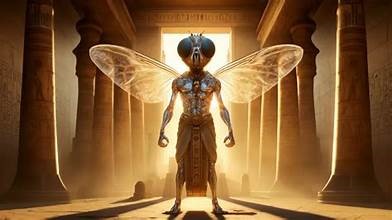
In this plague, the demon “Uatchit” (depicted below) is exposed as fraudulent. Uatchit, an Egyptian god with the head of a fly, is the god of protection, vigilance, and resilience. Egyptians have historically worn amulets (an object worn which is believed to bring success) depicting flies. The imagery of the fly and of the god Uatchit were given to Egyptian soldiers on their medals and placed on their graves; believing these things to bring protection and military resilience both in this life and in the afterlife. The plague of flies exposes Uatchit’s ineptitude to bring protection or resolve to the Egyptians.
5. The Plague on Livestock – Exodus 9:1-7
Again, Pharaoh refused to let the Israelites go free. Thus, the Lord spoke through Moses to Pharaoh, “‘The hand of the LORD will come with a very severe pestilence on your livestock which are in the field, on the horses, on the donkeys, on the camels, on the herds, and on the flocks. But the LORD will make a distinction between the livestock of Israel and the livestock of Egypt, so that nothing will die of all that belongs to the sons of Israel.’ The LORD set a definite time, saying, ‘Tomorrow the LORD will do this thing in the land,’” Exodus 9:3-5. Generally, wealth back in these days was measured by livestock and animals. The Egyptians had made the Israelites poor, through enslavement, and now the Lord was going to make the Egyptians poor. If the prior plagues had not caused the people of Egypt to pressure Pharaoh, maybe financially crippling the people would move Pharaoh’s heart.
Regarding this plague, a skeptic might say, “Of course the animals died due to the plague of insects. Flies tend to swarm around cattle and other barnyard animals, and flies spread disease which devastated the livestock.” While this might be a good argument, the fact that no animal amongst the Israelites was sickened or killed, revealed that this was truly, “The hand of the Lord.” Sometimes, people dismiss the obvious and call it coincidence.
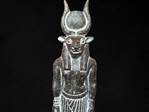
We know how much the Egyptians valued the cow, and made a worship of it. If you are familiar with the story of Moses going up onto Mt. Sinai, then you’ll recall that while the people of Israel were on the valley floor they made for themselves a false-idol to worship, a practice they’d learned in Egypt. Under Aaron’s direction, they made a golden idol in the shape of a calf. In this plague, the demon “Hathor” (depicted below) is exposed as fraudulent. Hathor was an Egyptian goddess of love and protection; depicted with the head of a cow, as a cow represented the maternal nature of her care for the herd, the masses. This plague destroying all the livestock exposes Hathor’s ineptitude to bring protection and watchfulness over the animals of Egypt.
6. The Plague of Boils – Exodus 9:8-12
Again, Pharaoh refused to listen to the Lord. A sixth plague was prophesied through Moses. God told Moses and Aaron, “Take for yourselves handfuls of soot from a kiln, and let Moses throw it toward the sky in the sight of Pharaoh. It will become fine dust over all the land of Egypt, and will become boils breaking out with sores on man and beast through all the land of Egypt. So they took soot from a kiln, and stood before Pharaoh; and Moses threw it toward the sky, and it became boils breaking out with sores on man and beast. The magicians could not stand before Moses because of the boils, for the boils were on the magicians as well as on all the Egyptians,” Exodus 9:8-11.
Egyptians and their animals were covered in boils. Boils are a festering blister that burns and itches. Impacting Egypt’s finances didn’t bring Pharaoh to a place of humility, so perhaps impacting his own health and the health of all the people might prove to be humiliating. There’s also intentional symbolism with the boils coming from the ashes of the kiln. Remember, that the Israelites were brick makers for the Egyptians (Exodus 1:14, 5:7). The bricks the Israelites made with mud and straw were fired in kilns. This was the main labor of their slavery, making storage facilities for Egypt (Exodus 1:11). Just as the kilns had been a painful burden to the Israelites, now the ashes of the kiln would be the source of pain for the Egyptians.
Once again, one might be tempted to dismiss these miracles of the Lord by justifying, “Of course the disease of the livestock produced a skin disease on the rest of the land. Outbreaks in animal groups tend to impact people; like bird-flu, salmonella, or other bacteria and disease.” This kind of thinking reflects the hardened heart of Pharaoh. Exodus 9:12 says, “And the LORD hardened Pharaoh’s heart, and he did not listen to them, just as the LORD had spoken to Moses.” Some might read this and think, “Wait, if the Lord was hardening Pharaoh’s heart, then why is Pharaoh guilty?” We must remember that Pharaoh already had a bitter and wicked heart (Exodus 7:14). Pharaoh’s disposition was one that was already ripe with sin. So, when God “hardened Pharaoh’s heart,” this simply means that the Lord held back the influence of His Spirit from Pharaoh’s heart, leaving Pharaoh’s heart in the condition of anger and bitterness that it was already in. Even a Christian at one time had a hard heart toward God (Genesis 6:5, 8:21, Jeremiah 7:24), and it’s only when God’s Spirit intervenes and brings us to a place of softness (Ezekiel 36:26) that our disposition changes.
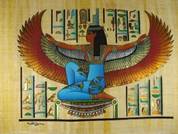
In this plague, the demon “Isis” (depicted below) is exposed as fraudulent. Isis was an Egyptian goddess of medicine and peace, and generally is depicted as having a large span of wings under her arms and either a throne on her head or a sun-disc. The plague of boils exposes Isis’ ineptitude to bring healing over Egypt.
7. The Plague of Hail – Exodus 9:13-35
God sees fit to remind Pharaoh that the only reason he and the rest of the Egyptians live at all is because God has spared them. “For if by now I had put forth My hand and struck you and your people with pestilence, you would then have been cut off from the earth. But, indeed, for this reason I have allowed you to remain, in order to show you My power and in order to proclaim My name through all the earth. Still you exalt yourself against My people by not letting them go,” Exodus 9:15-17. While God had brought some pestilence, it was a mild amount compared to what He could do. God is just, but God is also merciful. However, God’s righteousness insists that He will only hold off a deserving punishment for so long, as His goodness requires Him to bring justice. Though terrible, the lesser plagues didn’t produce repentance in Pharaoh’s heart, as the Lord left Pharaoh’s heart to his own wickedness.
Now comes the seventh plague of hail. “‘Behold, about this time tomorrow, I will send a very heavy hail, such as has not been seen in Egypt from the day it was founded until now. Now therefore send, bring your livestock and whatever you have in the field to safety. Every man and beast that is found in the field and is not brought home, when the hail comes down on them, will die.’ The one among the servants of Pharaoh who feared the word of the LORD made his servants and his livestock flee into the houses; but he who paid no regard to the word of the LORD left his servants and his livestock in the field,” Exodus 9:18-21.
You might be thinking, “Wait a minute, I thought all the livestock had died from the fifth plague?” We have to remember, that the killing of the livestock in the fifth plague applied at that time to only the cattle and livestock that was in the field during that plague, “a very severe pestilence on your livestock which are in the field.” This meant that any livestock during the fifth plague that was in the barn/storehouse was kept safe. Now, before the sixth plague comes, a warning goes out saying that all those who leave their animals, servants, or relatives outside will be killed, but all that are moved indoors will be spared. The text clarifies that some of the Egyptians were believing the Lord and had moved people and beasts indoors, “The one among the servants of Pharaoh who feared the word of the LORD made his servants and his livestock flee into the houses. Others continued to call Moses’ bluff, dismissing all the prior plagues as explainable acts of nature and not the handiwork of God, “but he who paid no regard to the word of the LORD left his servants and his livestock in the field.”
“Moses stretched out his staff toward the sky, and the LORD sent thunder and hail, and fire ran down to the earth. And the LORD rained hail on the land of Egypt. So there was hail, and fire flashing continually in the midst of the hail, very severe, such as had not been in all the land of Egypt since it became a nation. The hail struck all that was in the field through all the land of Egypt, both man and beast; the hail also struck every plant of the field and shattered every tree of the field. Only in the land of Goshen, where the sons of Israel were, there was no hail,” Exodus 9:23-26.
The sky unleased an attack which had not ever been seen before in the land; massive hail, fiery lightning strikes and the scariest noise of thunder. All of this booming destruction must have been as terrifying to live through as anything. Yet the region of Goshen was in peace as the Lord put a hedge of protection over them.
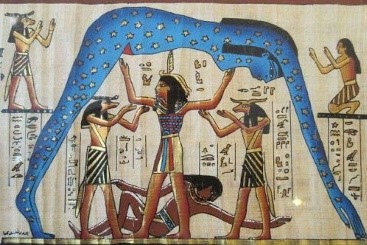
In this plague, the demon “Nut” (depicted below) is exposed as fraudulent. Nut was an Egyptian goddess of the sky; often depicted arching over the earth. Below you see her pictured in skin of sky blue and stars on her body. The plague of hail and lightning exposes the ineptitude of Nut having no control over the skies of Egypt.
8. The Plague of Locusts – Exodus 10:1-20
The hail storm prompts Pharaoh to ask Moses to pray to his God. Moses obliges, but knows that Pharaoh is still just giving him lip service, “As soon as I go out of the city, I will spread out my hands to the LORD; the thunder will cease and there will be hail no longer, that you may know that the earth is the LORD’S. But as for you and your servants, I know that you do not yet fear the LORD God,” Exodus 9:29-30.
The hail storm destroyed the crop of flax and barley, but the wheat crop was about to come forth and still able to spring up. Seeing that Pharaoh was still refusing the let the Israelites go, God brought forth the eighth plague; locusts to consume what crop was left. Moses spoke for God and warned Pharaoh, “For if you refuse to let My people go, behold, tomorrow I will bring locusts into your territory. They shall cover the surface of the land, so that no one will be able to see the land. They will also eat the rest of what has escaped -what is left to you from the hail -and they will eat every tree which sprouts for you out of the field. Then your houses shall be filled and the houses of all your servants and the houses of all the Egyptians,” Exodus 10:4-6.
Hearing the details of this forthcoming plague, Pharaoh starts to negotiate with Moses. Pharaoh starts by pretending that he will release the Israelites, but wants to know who exactly is requesting to go into the wilderness on this three-day journey to worship the God of Israel. Pharaoh says, “Go, serve the LORD your God! Who are the ones that are going?”, Exodus 10:8. Pharaoh seems to think that if they all go, then they’ll never come back. So, he wants to make sure that not everyone is leaving town. Moses reiterates that everyone in Israel is needing to go; man, woman, child, and animal. “We shall go with our young and our old; with our sons and our daughters, with our flocks and our herds we shall go,” Exodus 10:9. Afterall, this was always God’s demand, that all Israel be released (Exodus 5:1-3).
To this, Pharaoh sarcastically replies, “Thus may the LORD be with you, if ever I let you and your little ones go!” Pharaoh is basically saying, “I’m not letting you take your kids. You can have your God’s blessing on your journey to the extent that I’m giving you permission to take your whole family, which is none!” Pharaoh goes on to say, “Evil is in your mind. Not so! Go now, the men among you, and serve the LORD,” Exodus 10:9-10. In other words, Pharaoh said, “You plan to leave and never return! No way! Your men can go, but the kids will be my hostages until you return. Now, with that condition, take your men and go worship your God.”
This was obviously unacceptable to God, so the next plague was sent. “The LORD directed an east wind on the land all that day and all that night; and when it was morning, the east wind brought the locusts…There had never been so many locusts, nor would there be so many again,” Exodus 10:13-14. Again, Pharaoh pleaded with Moses and Aaron to ask God to relent. Moses prayed and God responded. “The LORD shifted the wind to a very strong west wind which took up the locusts and drove them into the Red Sea; not one locust was left in all the territory of Egypt,” Exodus 10:19. To bring in the locusts the Lord directed the east wind. To remove the locusts, the Lord directed the west wind. Nonetheless, Pharaoh’s hard remained hard.
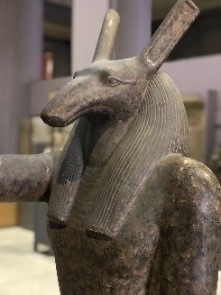
In this plague, the demon “Seth” (depicted below) is exposed as fraudulent. Seth was an Egyptian god of deserts and storms/wind; believed to control wind and cause a sand storm to come or go. He’s depicted as a human with the head of a mythological beast of no specific specie. The plague of locusts as brought in by the wind, exposes the ineptitude of Seth in having no control over the winds and deserts of Egypt.
9. The Plague of Darkness – Exodus 10:21-29
With Pharaoh’s heart still unwilling to let the people go, a ninth plague was sent by God. “‘Stretch out your hand toward the sky, that there may be darkness over the land of Egypt, even a darkness which may be felt.’ So Moses stretched out his hand toward the sky, and there was thick darkness in all the land of Egypt for three days,” Exodus 10:21-22.
Some might dismiss this plague by saying, “Of course there was darkness over Egypt. After the locusts had devoured any remaining vegetation, there would be no plant left to keep the dust down. This was probably just a massive dust storm, darkening the sky, which the deserts of that region are prone to experience.” That may be logical, except that, “They did not see one another, nor did anyone rise from his place for three days, but all the sons of Israel had light in their dwellings,” Exodus 10:23. Even in a heavy dust storm you could still see people inside your home, or even outside if they stood close enough to you. Here, a supernatural darkness covered Egypt so that even indoors people couldn’t see each other. Yet Goshen enjoyed light as any other day. And not just the Israelites whose house was in Goshen, as most were, but there was light for the households of the Israelites who were living in homes scattered around Egypt. We know some Israelites were in homes throughout Egypt as the tenth plague made distinction about households by their doorposts, and also mentions that Israelites asked for gold/silver from their Egyptian neighbor (Exodus 11:2).
The emphasis of light, “in their dwellings,” shows that indoors the Egyptians couldn’t even use fire to give off light. It could be that what produced this heavy darkness was a type of wet fog that kept candles, torches, or lamps from even being able to be lit. Whatever it was, it could “be felt” physically (Exodus 10:21). Apparently, though the Egyptians couldn’t see their hand in front of their face, the Egyptians could somehow distinguish that the Israelites were set apart from this plague. The previous plague of locusts “darkened the land,” (Exodus 10:15) but nothing like this. This brought terror to the people.
The darkness compels Pharaoh to negotiate once again, “Go, serve the LORD; only let your flocks and your herds be detained. Even your little ones may go with you,” Exodus 10:24. This time Pharaoh says all the people can go, but they must leave their animals behind. Moses won’t compromise and says, “You must also let us have sacrifices and burnt offerings, that we may sacrifice them to the LORD our God. Therefore, our livestock too shall go with us; not a hoof shall be left behind,” Exodus 10:25-26. Pharaoh, as stubborn as ever, won’t have it and his heart remained hard. In anger, Pharaoh said, “Get away from me! Beware, do not see my face again, for in the day you see my face you shall die!” To this Moses said, “You are right; I shall never see your face again!”, Exodus 10:28-29.
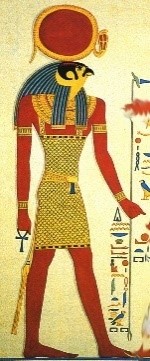
In this plague, the demon “Ra” (depicted below) is exposed as fraudulent. Ra was one of the most prominent Egyptian gods, the sun god. Ra is usually depicted as having a spherical sun shape over the head of a falcon. This plague of darkness obviously exposes the ineptitude of Ra in that he has no control over the sun and its ability to bring light to Egypt.
10. The Plague of Killing the Firstborn of Man and Beast – Exodus 11, 12:1-30
By this time, everyone except Pharaoh wanted the Israelites out of Egypt. God had one more plague though to display His power and to bring Pharaoh to his knees. “Now the LORD said to Moses, ‘One more plague I will bring on Pharaoh and on Egypt; after that he will let you go from here. When he lets you go, he will surely drive you out from here completely. Speak now in the hearing of the people that each man ask from his neighbor and each woman from her neighbor for articles of silver and articles of gold.’ The LORD gave the people favor in the sight of the Egyptians. Furthermore, the man Moses himself was greatly esteemed in the land of Egypt, both in the sight of Pharaoh’s servants and in the sight of the people,” Exodus 11:1-3.
God has the Israelites prepare to leave Egypt, but not before they plundered Egypt of their wealth. God was going to see that the hard labor the Israelites endured would now be settled up in gold and silver. Many of these pieces of jewelry were no doubt fashioned into forms of the Egyptian gods, but these pieces would eventually be melted down and made into utensils and items fit for service of the Lord (Exodus 25:3).
Moses spoke before the hearing of the people, “Thus says the LORD, ‘About midnight I am going out into the midst of Egypt, and all the firstborn in the land of Egypt shall die, from the firstborn of the Pharaoh who sits on his throne, even to the firstborn of the slave girl who is behind the millstones; all the firstborn of the cattle as well. Moreover, there shall be a great cry in all the land of Egypt, such as there has not been before and such as shall never be again. But against any of the sons of Israel a dog will not even bark, whether against man or beast, that you may understand how the LORD makes a distinction between Egypt and Israel,” Exodus 11:4-7.
Despite the total outcry and terror that would come over the Egyptians, a great peace would rest upon Israel, “a dog will not even bark.” To enjoy this peace though, Israelites would have to prepare for an event known as “the Passover.” God gave Moses instructions to give to the Israelites, “On the tenth of this month they are each one to take a lamb for themselves, according to their fathers’ households…Your lamb shall be an unblemished male a year old; you may take it from the sheep or from the goats. You shall keep it until the fourteenth day of the same month, then the whole assembly of the congregation of Israel is to kill it at twilight. Moreover, they shall take some of the blood and put it on the two doorposts and on the lintel of the houses in which they eat it,” Exodus 12:3-7. This blood served as a marker to know which household revered the Lord or not. “For I will go through the land of Egypt on that night, and will strike down all the firstborn in the land of Egypt, both man and beast; and against all the gods of Egypt I will execute judgments -I am the LORD. The blood shall be a sign for you on the houses where you live; and when I see the blood I will pass over you, and no plague will befall you to destroy you when I strike the land of Egypt,” Exodus 12:12-13.
Fast forward, the evening of the Passover came. “Now it came about at midnight that the LORD struck all the firstborn in the land of Egypt, from the firstborn of Pharaoh who sat on his throne to the firstborn of the captive who was in the dungeon, and all the firstborn of cattle. Pharaoh arose in the night, he and all his servants and all the Egyptians, and there was a great cry in Egypt, for there was no home where there was not someone dead. Then he called for Moses and Aaron at night and said, ‘Rise up, get out from among my people, both you and the sons of Israel; and go, worship the LORD, as you have said. Take both your flocks and your herds, as you have said, and go, and bless me also,’” Exodus 12:29-32.
The heir to Pharaoh’s throne was now dead. The firstborn of every household was now dead. Remember that after the ninth plague, all of Egypt, except Pharaoh, wanted the Israelites to go. Pharaoh alone was responsible for the tenth and final plague. The people knew it. If they hadn’t loathed Pharaoh by this point, certainly now all of Egypt had a reason to hate Pharaoh personally, and worshipping Pharaoh as their great and mighty god would be tainted. From the throne-room to the dungeon, no family was safe; the joy of the Egyptian families was killed. There would be none to get encouragement from as every neighbor was suffering the same trauma. I wonder how many survivors of the ten plagues ever said, “By the mercies of the God of Israel, I am alive.” Would the hearts of the survivors turn and worship the one true God?
This plague, known as The Passover, is a foreshadowing of what Jesus has done. We are cursed to die, because of our wicked ways. Yet, to those that would trust the blood of the lamb, for these believers the wrath of God will Passover them. Jesus is the Lamb of God; a spotless and worthy sacrifice, whose blood covers the sin of those who trust Him.
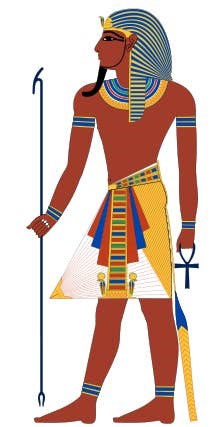
In this plague, the deity of Pharaoh (depicted below) is exposed as fraudulent. Pharaoh was considered the greatest god over Egypt, and was thought to be the incarnate son of Ra. Pharaoh’s deity is exposed as fraudulent as Pharaoh was shown to be nothing more than a human who was incapable of saving his firstborn from the wrath of the true God.
Conclusion
Exodus 11:9, “Then the LORD said to Moses, “Pharaoh will not listen to you, so that My wonders will be multiplied in the land of Egypt.” God’s plan was to make His name known, and to be worshipped, in both Egypt, and all around the world. He knows that Satan is competing for the hearts of men, by leading many astray with false gods and false faiths. God wants the world to know that He alone is worthy to be praised.
Exodus 20:2-5, “I am the LORD your God, who brought you out of the land of Egypt, out of the house of slavery. You shall have no other gods before Me. You shall not make for yourself an idol, or any likeness of what is in heaven above or on the earth beneath or in the water under the earth. You shall not worship them or serve them; for I, the LORD your God, am a jealous God.”